
If you are searching for MBBS in China fees, you probably already know one thing: private medical colleges in India are painfully expensive. A management quota seat can cost anywhere between 60 lakh and 1.5 crore rupees. That is simply out of reach for most middle-class families.
China solves that problem for thousands of students every year. When you add up the complete MBBS in China fees, including tuition, hostel, food, and everything else for the full six years, the total usually falls between 25 and 45 lakh rupees, depending on which university and city you choose. That is still well below what you would pay for a private seat back home.
I have been helping students go to China for medical studies for over a decade now, and the first question every parent asks me is the same: “China me MBBS ki fees kitni hai, exactly?” So in this guide, I will give you the exact numbers, university by university, year by year, based on the official 2026-intake fee schedule, with no sugar-coating. I will also tell you about the hidden costs that most agents conveniently forget to mention.
MBBS in China Fees Structure 2026 – Year-Wise Breakdown
The MBBS course in China runs for six years. That is five years of classroom and clinical study plus one year of internship. Most universities charge tuition annually, and the good news is that the fee stays fixed for all six years. What you pay in year one is what you pay in year six, which makes MBBS in China fees easy to plan.
Here is what a typical year looks like, based on the official 2026-intake fee schedule covering 44 government medical universities.
Tuition fees across these universities range from RMB 21,000 (the most affordable option) to RMB 60,000 per year (the most premium option), with the majority of universities falling between RMB 30,000 and RMB 40,000. In dollar terms that is roughly $2,900 to $8,250, or about 2.5 to 7.3 lakh rupees per year. Hostel fees add another RMB 1,600 to RMB 11,000 per year on top of the core MBBS in China fees, depending on the university and room type.
The first year is always the heaviest on your pocket. Along with tuition and hostel, you pay one-time charges like the application fee, insurance, resident permit, medical examination, and your flight ticket. Budget an extra 1 to 1.5 lakh rupees for these first-year expenses.
From the second year onwards, things settle down. You mainly pay tuition, hostel, insurance renewal, and residence permit renewal. A small tip from my experience: some universities give a discount if you pay the full year’s fee before the deadline, so always ask the international office about early payment offers.
MBBS in China Fees in Indian Rupees Quick Cost Table
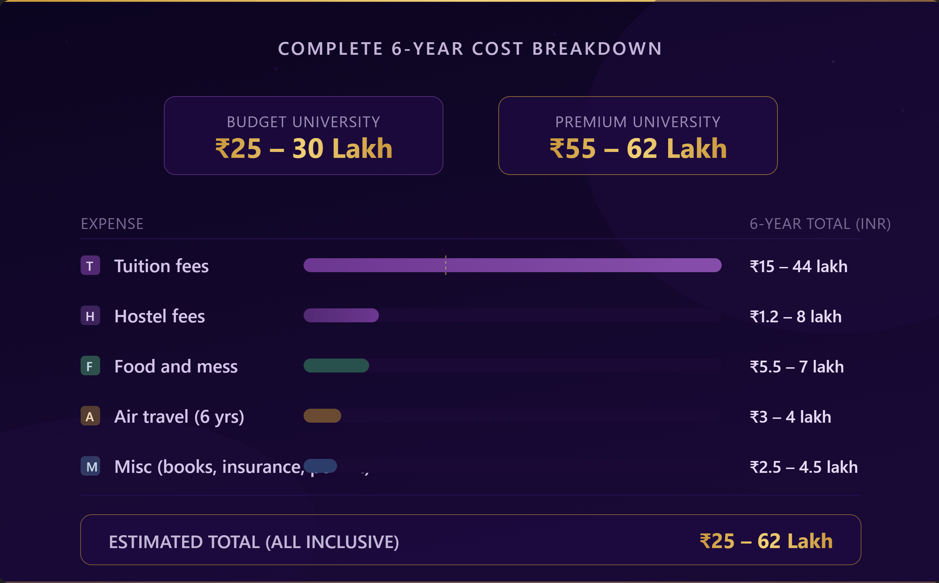
Parents always tell me that dollar figures confuse them, so here is the full picture converted into rupees. This table shows the estimated cost for the entire six-year program (calculated at 1 USD = ₹88, approximate rates for 2026), covering the full range from budget to premium universities.
| Expense Head | Per Year (USD) | Per Year (INR) | 6-Year Total (INR) |
| Tuition Fees | $2,900 – $8,250 | ₹2.5 – 7.3 lakh | ₹15 – 44 lakh |
| Hostel Fees | $220 – $1,510 | ₹19,000 – 1.3 lakh | ₹1.2 – 8 lakh |
| Food & Mess | $1,000 – $1,400 | ₹90,000 – 1.2 lakh | ₹5.5 – 7 lakh |
| Health Insurance | ~$110 (RMB 800/year) | ~₹9,700 | ~₹58,000 |
| Resident Permit Renewal | ~$55 (RMB 400/year) | ~₹4,800 | ~₹29,000 |
| Misc. (books, local travel, phone) | $400 – $700 | ₹35,000 – 60,000 | ₹2 – 3.6 lakh |
| Total Cost | $4,700 – $11,600 | ₹4.1 – 10.2 lakh | ₹25 – 62 lakh |
If you pick one of the true budget universities (like Beihua University or China Three Gorges University), your total can come down to around 25 to 30 lakh rupees for all six years. Choose a top-tier university in a big city Shantou, Capital Medical, Tianjin Medical, or Dalian and the same table can cross 55 to 60 lakh, mainly because of higher tuition and higher living costs.
Cheapest MBBS Fees Universities and Their Tuition Fees
Now the question everyone loves: which is the cheapest MBBS in China? Before I list the names, one honest warning from my side. Only apply to universities approved for English-medium MBBS by China’s Ministry of Education, and always verify that the degree is accepted under NMC (National Medical Commission) guidelines in India. The NMC rules require your foreign degree to include proper clinical training and a licence-eligible pathway, so never chase the lowest fee blindly. A cheap degree that fails NMC norms is the most expensive mistake you can make.
That said, here are realistic china medical university fees for the 2026 intake, based on the official fee schedule. Always cross-check on the university’s own site before paying anything, because agents sometimes quote inflated numbers.
At the true budget end, Beihua University charges around RMB 21,000 per year, the lowest tuition on the entire 2026 list, and China Three Gorges University comes in at RMB 24,000. Nantong University (RMB 26,000) and Ningxia Medical University (RMB 29,800) are also strong budget picks. In the RMB 30,000 bracket you have a large cluster of well-known names, including Kunming Medical University (RMB 35,000, and a bonus for Indian students because Kunming’s weather feels like Bangalore), Anhui Medical University (RMB 31,000, with a large Indian student community), Qingdao University (RMB 30,000), Shihezi University (RMB 30,000), Guangzhou Medical University (RMB 30,000), Wenzhou Medical University (RMB 30,000), Harbin Medical University (RMB 30,000), and Chongqing Medical University (RMB 30,000). Xuzhou Medical University sits close by at RMB 33,000.
On the premium side, big names like Jilin University (RMB 36,000), Zhengzhou University (RMB 35,000), and China Medical University (RMB 40,000) charge more, but they offer stronger hospital exposure and better global rankings. At the very top of the fee ladder sit Shantou University (RMB 60,000), Capital Medical University (RMB 50,000), Sun Yat-Sen University (RMB 48,000), Tianjin Medical University (RMB 48,000), and Southern Medical University (RMB 45,000) all reputed institutions, but priced well above the average.
Here is a practical piece of advice I give every family: don’t pick a university only because it is a few thousand rupees cheaper per year. Look at the FMGE/NExT passing history of its Indian graduates, the size of its affiliated hospitals, and how long it has been running the English-medium program. A slightly higher mbbs fee in china often buys you far better clinical training.
MBBS in China Hostel Fees and Monthly Living Costs
Let’s talk about daily life, because this is where students actually feel the pinch or the relief. The mbbs in china hostel fees are honestly one of the best parts of the whole deal.
Most universities give international students twin-sharing rooms with attached bathrooms, heating, Wi-Fi, and sometimes even a small kitchen area on each floor. Across the 2026 fee schedule, hostel costs range widely from as low as RMB 1,600 per year at the cheapest end (Xiamen University) to around RMB 11,000 per year at universities with premium accommodation (such as Dalian Medical University and Tianjin Medical University), with most universities charging somewhere between RMB 4,000 and RMB 8,000 per year. In rupees, that is roughly ₹2,000 to ₹13,000 per month depending on the university. Compare that with a private hostel in any Indian metro and you will see why parents smile at this number.
A few universities (like Zhengzhou University) charge hostel fees on a monthly basis instead of a fixed annual figure, so always confirm the exact billing structure with the international office before you budget.
Food is the next big item. University canteens serve meals for RMB 10 to 15 per meal, so about ₹120 to ₹180. Most campuses with a big Indian crowd also have Indian mess facilities run by local vendors, charging around RMB 800 to 1,000 per month for full meals. If you cook yourself, you can manage in even less. Rice, vegetables, eggs, and chicken are all cheap in Chinese supermarkets.
One of my students, Rahul from Patna, tracked every rupee during his first year at Kunming. His total monthly spend, including food, mobile recharge, local metro travel, and the occasional weekend outing, came to about ₹14,000. That is his real number, not a brochure figure. Budget ₹12,000 to ₹18,000 per month and you will live comfortably.
Hidden Costs in the Total Cost of China
This is the section most websites skip, and it is exactly why I insisted on writing it. When parents calculate the china mbbs cost, they usually add tuition plus hostel and stop there, assuming MBBS in China fees end at the brochure figure. Then the surprises start arriving.
First, there is the one-time bundle in year one, based on the official fee schedule: application fee (around RMB 600), insurance (around RMB 800 per year), resident permit (around RMB 400 per year), medical examination in China (around RMB 350), and books (around RMB 500 approx). On top of this, add medical tests done in India before you leave, which typically cost ₹8,000–12,000. None of these are scams; they are official charges. They just never appear in the shiny fee poster.
Second, flight tickets. A Delhi or Mumbai to China round trip costs ₹35,000 to ₹60,000 depending on season. Over six years, most students fly home once or twice a year, so keep ₹3 to 4 lakh aside for travel across the whole course.
Third, an important requirement that is easy to miss: the CSCA test is mandatory for all students under the 2026 intake fee structure. You will need to appear for this exam as part of the university admission requirements check the official CSCA website for the exact process and schedule before you apply.
Fourth, the exam and licensing costs after graduation. You will need to clear the FMGE or NExT exam to practise in India, and many students take coaching for it, which costs ₹50,000 to ₹1.5 lakh. Also budget for HSK Chinese language classes during the course, because you will need basic Mandarin to talk to patients during clinical rotations. Some universities include this in tuition; many charge separately.
Finally, currency fluctuation. The rupee has slowly weakened against the dollar and yuan over the years. A fee that costs ₹3.5 lakh today might cost ₹3.8 lakh in your fourth year. I always tell families to keep a 10 percent buffer over the calculated total. Honest planning today saves panic later.
Scholarships That Can Reduce Your MBBS in China Fees
Here is some genuinely good news. China is one of the few countries where medical scholarships for international students actually exist in meaningful numbers, and they can seriously cut your mbbs in china tuition fees.
The biggest one is the CSC (Chinese Government Scholarship). It can cover full tuition, hostel, and even give a monthly stipend of around RMB 3,000. The catch? It is highly competitive and most medical seats under CSC are limited, so you need a strong academic profile, ideally 85 percent or above in PCB, and you must apply early, usually between December and March for the September intake.
Then there are provincial and university-level scholarships. Many universities offer first-year merit scholarships of RMB 5,000 to 20,000 to students with strong NEET scores and 12th-grade marks. Some also give renewal scholarships every year if you top your class. One of my students at Zhengzhou got a discount on her second-year fee just by staying in the top ten of her batch.
My practical tip: apply directly through the university’s international admissions page and specifically ask, in writing, what scholarships are available for the 2026 intake. Agents rarely push scholarships because discounted fees mean lower commissions for them. Yes, I am telling you an industry secret here.
MBBS in China Fees Compared with Other Countries
So how does China stack up against the other popular MBBS destinations? Let me give you the honest comparison I share in my counselling sessions.
Russia costs roughly ₹25 to 45 lakh in total, quite similar to China, but the extreme winters and the current geopolitical situation worry many parents. Kazakhstan and Kyrgyzstan are cheaper on paper, around ₹20 to 30 lakh total, but the infrastructure and hospital exposure at many universities there simply do not match China’s government medical universities.
The Philippines runs ₹30 to 45 lakh, with the advantage of full English-speaking patients but the disadvantage of a BS+MD structure that stretches your timeline. Georgia costs ₹30 to 50 lakh. Bangladesh is excellent academically but its good colleges now charge ₹40 to 55 lakh, and seats are fiercely competitive.
Against all of these, the china medical college fees for indian students offer a rare combination: a genuinely wide range from budget (₹25 lakh) to premium (₹55–60 lakh) options, world-class infrastructure, huge affiliated hospitals with thousands of beds, and universities that regularly appear in global rankings. The one genuine drawback is the language barrier with patients, which is why learning Mandarin sincerely from your first year matters so much.
My balanced verdict after guiding hundreds of students: if your budget is 25 to 40 lakh and you want strong labs, big hospitals, and a structured system, China deserves a spot in your top two options. If you cannot commit to learning basic Chinese, look at the Philippines or Bangladesh instead. There is no shame in choosing what suits you.
FAQs About MBBS in China Fees
1. China me MBBS ki fees kitni hai?
China me MBBS ki tuition fees RMB 21,000 se RMB 60,000 per year hai, yaani lagbhag ₹2.5 lakh se ₹7.3 lakh har saal (zyaadatar universities RMB 30,000–40,000 ke beech aati hain). Hostel aur khaane ka kharcha milakar, ek saal ka total ₹4 se 10 lakh ke beech aata hai, university par depend karta hai. Poore 6 saal ka kharcha aam taur par ₹25 se 45 lakh hota hai, budget universities mein aur bhi kam ho sakta hai.
2. What is the total cost of MBBS in China for Indian students?
The total cost of MBBS in China for the full six-year program, including tuition, hostel, food, insurance, visa, and travel, is typically ₹25 to 45 lakh. Budget universities like Beihua University or China Three Gorges University can bring it down to around ₹25 lakh, while top-ranked, big-city universities like Shantou or Capital Medical University can push it to ₹55–60 lakh or more.
3. Which is the cheapest medical university in China for MBBS?
Based on the official 2026-intake fee structure, Beihua University has the lowest tuition on record at RMB 21,000 per year, followed by China Three Gorges University at RMB 24,000 and Nantong University at RMB 26,000. Just make sure any university you choose is on the Ministry of Education’s approved list for English-medium MBBS and meets NMC guidelines.
4. Are MBBS in China fees payable in one go or year by year?
Fees are paid year by year, usually at the start of each academic session in September. You do not need to pay the full six-year amount upfront. Some universities even offer small discounts for early annual payment, so ask the international office directly.
5. Can Indian students get a scholarship for MBBS in China?
Yes. The Chinese Government Scholarship (CSC) can cover tuition, hostel, and a monthly stipend, though medical seats under it are limited and competitive. Many universities also offer merit scholarships of RMB 5,000 to 20,000 based on your NEET score and 12th marks, so always apply early and ask in writing.
6. Is there any mandatory test besides NEET for MBBS in China admission?
Yes as per the 2026 intake fee structure, the CSCA test is mandatory for all applicants. Check the official CSCA website for details on the exam format and schedule before you begin your application

Pingback: NMC Approved Medical Colleges in China 2026 – Full List & Guide